
Translating widespread voter support for water infrastructure into concrete policy action remains a major challenge in the U.S. 92% of voters identify water access as important and show strong bipartisan support for protections. Polls show that voters strongly support investment in the nation’s water and sewer systems, worry about drought, flooding, and contamination, and want the government to help communities prepare for extreme weather. Furthermore, 90% of voters agree safe and affordable water is a human right and 88% are concerned about pollution of lakes and rivers.
But this consensus has yet to turn into policy action. The reasons for this are varied: from water being undervalued and perceived as a hyperlocal issue to bureaucratic and jurisdictional hurdles and political swings. Still, there is a latent opportunity to activate that support to spark policy change. Texas recently showed us the way.
Purpose: more collaboration
Communication campaigns have an important role to play in this translation work, as they offer a way for people to pressure politicians to act on water. But, too often, these efforts happen in silos, creating competition and fragmentation where there should be alignment. We need to coordinate communication around a shared vision in order to be most effective. . Can we work collaboratively on more impactful campaigns? Hopefully yes, and to do so, we first need to understand what is currently happening in terms of national water campaigns.
This landscape mapping analysis examines the ecosystem of U.S. national communication campaigns related to water, including those associated or contained within climate, wildlife conservation, and social justice. Our analysis identified and reviewed over 40 campaigns to assess strategic gaps, messaging overlaps, and coordination opportunities. Our goal is to inform other non-profit organizations, philanthropic funders, Tribal nations, and water advocates about ongoing campaigns in the hope we can avoid duplicating efforts and competing unnecessarily to complement each other instead.
Landscape overview
The water campaign ecosystem reflects the fragmentation of the water sector at large, but it’s evolving with more collaborative efforts emerging in recent times. We identified and selected 17 efforts focused at the national level (without including government campaigns), listed them by chronological order and grouped them into four categories:
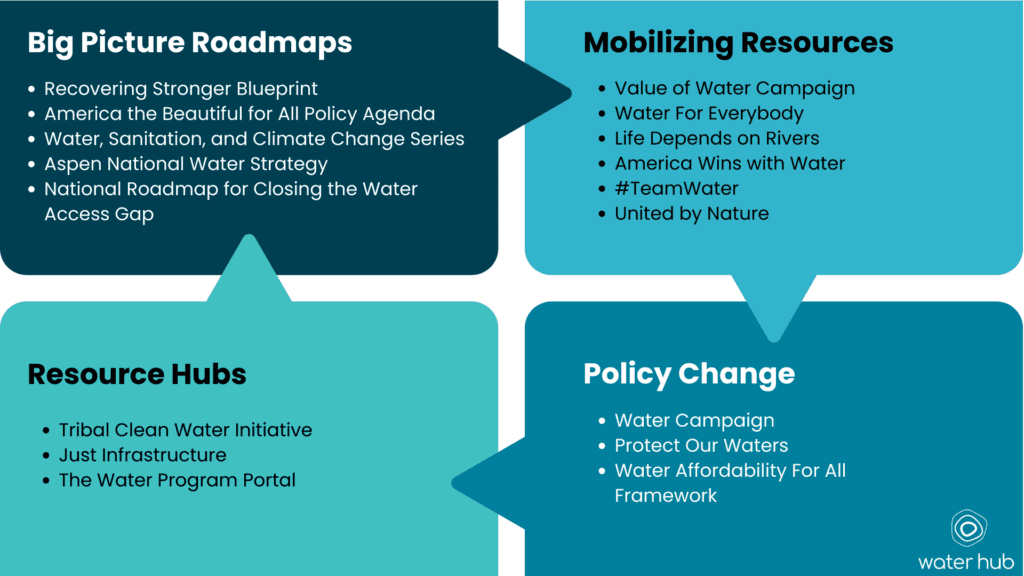
Big Picture Roadmaps are research-based frameworks that provide policy blueprints for an array of actors, from water agencies to government, nonprofits, and the private sector.
- Recovering Stronger Blueprint (2020): a blueprint for the government to make water investments and policies for pandemic crisis recovery
- America the Beautiful for All Policy Agenda (2024): advise for the government to protect 30% of lands/waters by 2030 with a Justice40 metric
- Water, Sanitation, and Climate Change in the US Series (2022): research to close the knowledge gaps around climate change, water, and equity
- Aspen National Water Strategy (2026): strategies for companies, NGOs, and government to ensure water security for people, economies, and ecosystems
- National Roadmap for Closing the U.S. Water Access Gap (2026): Vessel’s National Action Plan, grounded on how and why WASH access gaps persist
Mobilizing Resources Campaigns are efforts that focus on directing public funds, fundraising, crowdfunding, and mobilizing the public to prioritize water investments.
- Value of Water Campaign (2015): a campaign for the public and policymakers on how water is essential and in need of investment
- Water For Everybody (2024): a campaign for the general public to raise awareness and drive action to ensure water justice for all
- Life Depends on Rivers (2024): a fundraising campaign to secure $100 million over four years to transform river health
- America Wins with Water (2025): an awareness campaign to bring attention to federal water investments
- #TeamWater (2025): a fundraising and awareness campaign by influencers MrBeast and Mark Rober to raise $40M for clean water for 2 million people
- United by Nature (2026): Nature Is Nonpartisan’s initiative to build the 21st-century conservation movement by activating everyday Americans
Policy Change Campaigns are efforts with a focus on advocacy regarding a specific group of water policy and finance initiatives and programs.
- Water Campaign (2017): a campaign to advance equitable policies that promote and increase clean water protections
- Protect Our Waters* (2022): an effort to strengthen water protections at the state and federal level in the face of Clean Water Act attacks
- Water Affordability For All Framework* (2024): a framework for policy makers to advance water, climate, and justice solutions
Resource Hubs are primarily repositories of information, case studies, templates, and recommendations for water advocacy.
- Tribal Clean Water Initiative (2021): a resource for policymakers to achieve access to safe drinking water for Native communities
- Just Infrastructure (2024): a messaging resource for nonprofit partners and changemakers to push for equitable water spending and future funding
- The Water Program Portal (2025): a digital information hub for organizations and public agencies tracking recent federal investments in water
*The Protect Our Waters and Water Affordability for All campaigns work together to coordinate their advocacy efforts.
Audience findings: building bottom-up
When analyzing the overlaps and gaps in terms of target audiences of water campaigns we found significant inefficiencies: from a policy advocacy concentration that may exhaust lawmakers with repetitive messaging, to a crowded public square where campaigns compete rather than collaborate for attention. Despite a rising focus on equity, significant gaps remain in genuinely engaging rural and Tribal communities and leveraging culture to reach people where they get their information on social media. We identify four specific points of friction and opportunities to transform this scattered energy into a cohesive, high-impact movement:
- Policy advocacy concentration: Multiple campaigns target the same congressional committees for infrastructure funding, Clean Water Act protections, and affordability measures, potentially creating risk of message fatigue among policymakers.
- Opportunity: Joint policy advocacy effort that links source water protection and infrastructure investment with safe and affordable drinking water.
- Competing for the public’s attention: Multiple campaigns target the general public to build political will or raise funds but compete for attention with similar broad messages about water’s importance as an economic and public health driver.
- Opportunity: Align and integrate under a single awareness campaign with multiple benefits.
- Rural and Tribal communities overlooked: Newer campaigns (2023+) increasingly claim to center justice. However, true collaboration with and representation of Tribal Nations and rural communities is still rare, meaning there is an intent but a gap in the action.
- Opportunity: Re-build trust and co-create with rural and Tribal communities
- Digital-first culture overlooked: Campaigns are slow to adopt new tools and tactics, such as engaging creators and embracing social media
- Opportunity: Work with content creators and meaning-makers to translate complex jargon into relatable stories
Messaging findings: uplifting underrepresented issues
Despite important growth in the last five years, national water campaigns still overlook key issues, from Tribal and agricultural stewardship to groundwater depletion. Newer campaigns are increasingly breaking out of “water-only” silos to connect with climate, justice, and public health. We found three points on how to close these representation gaps to make water a top-of-mind concern that reflects more accurately its depth and complexity:
- Underrepresented issues: There is very limited tailored messaging for agricultural water stewardship including private well owners (13% of households that are rarely addressed in national campaigns) and Spanish speakers (less than 10% of campaigns offer robust bilingual assets despite disproportionate water burdens). Similarly, campaigns honoring sovereignty and Indigenous knowledge are scarce. Surface water dominates while depletion of underground resources lacks dedicated narrative.
- Opportunity: Develop comprehensive story bank unpacking underrepresented issues
- Cross-sector connection growing: While most campaigns tend to be water-only campaigns (40%) and a minority connect to climate resilience (25%), environmental justice (15%) and wildlife conservation (12%) and oceans (8%), there is a positive trend to integrate across issues, with 60% of newer campaigns (launched 2023+) explicitly linking water to climate or justice, up from 25% of legacy water campaigns.
- Opportunity: Unify people around top-of-mind issues like health, housing, justice, food, cost of living, energy and fuel prices, and public lands through a messaging playbook and a shared vision for thriving communities and waterways
- Address deregulation and disinformation: Minimal shared resources to respond to anti-regulatory or privatization narratives, and even less address disinformation and misinformation that come along with those agendas.
- Opportunity: Develop a rapid response channel that tracks and addresses opposing efforts
Forthcoming efforts
We are currently completing a messaging playbook that will include an overview of messaging research, guidance on winning water messages and narrative strategies for building a broad, nonpartisan movement for clean water. We will share this new resource with water advocates nationwide via virtual and in-person workshops and presentations, starting with an event at River Rally in May. We are also conducting a communications infrastructure assessment with input from movement leaders to identify priorities for investment, from increasing cross-campaign collaboration to scaling digital best practices, engaging creators, and reaching underrepresented audiences.
This landscape analysis suggests a need for integration rather than new campaigns. While there is certainly no such thing as too many water campaigns during an urgent time for water nationally, the sector can work more strategically with better alignment internally and more inclusivity externally. Water communications infrastructure exists, but it is fragmented. The energy and funding going towards water campaigns can and should be more intentionally directed away from duplicative campaigns and toward collaborative efforts. At the Water Hub, we have been applying these strategies to work with partners and engage communities around shared values and relevant messaging. We have conceptualized a
“Water Creator Council” and recently hosted webinars for organizations interested in engaging with creators and how to integrate edutainment in your campaigns. We want to co-create narratives and build resources for those working in water. If you’re interested, reach out to us!
What’s next?
Sign up for our Water Cooler newsletter to hear about our trainings and resources and follow us on LinkedIn, Bluesky, Instagram, and YouTube.