
Recently, Briana and I visited Christensen Farms in Lyons, Nebraska, to get up close to a regenerative family farm for our latest short documentary. Check it out below!
From Omaha, we drove into the heart of America’s breadbasket. For me, rural communities can feel like stepping into a different world. From Southern California cars corralled in freeway arteries, I watched golden fields dotted with tractors and cattle pass us by.
When we rolled up, a farm dog greeted us, wagging her tail next to a big red barn, her person, Graham Christensen, waving at us closely behind. Graham is a fifth-generation farmer and founder of GC Resolve and co-founder of RegeNErate Nebraska, who believes in farmer-based solutions for our climate and food challenges. After some time away building complementary skills and climate know-how to farm differently, Graham and his brother Max came back home to where the Christensen family has been rooted and farmed for over 150 years.
Graham uses his regenerative farm as a demonstration and educational tool for everyone, from youth to decision-makers, to fill knowledge gaps and to advocate for better policy to change food systems.
6 principles of regenerative agriculture
So what is regenerative agriculture?
- “No-till”: The industrialized agriculture status quo churns soil, disrupting life underground and a healthy soil structure. Farms like Graham’s model a more natural approach, letting soil keep healthy bonds through “no-till.”
- Permanent roots: Year-round cover crops help control erosion and infuse important nutrients, like nitrogen, to keep soil healthy.
- Soil armor: Above ground, broken-down plants are like a blanket, keeping soil insulated from extreme temperatures, protecting it from strong winds, and (you guessed it) more erosion.
- Biodiversity: Planting different flowering plants invites back helpful pollinators, birds, and other critters.
- Livestock: Grazing animals mimic how bison would roam the prairie, loosening compacted soil and fertilizing the land.
- “Ecosystem context”: What works in Nebraska isn’t going to work in California’s Central Valley. Success depends on adapting to the local environment.
Regenerative agriculture in action
You could say that Graham doubles as a grain farmer and a healthy soil farmer. On day one, we joined a tour with local college students with Sustain UNL, where Graham gave us a look into his cover crop fields. Here, we learned how growing plants like legumes keep roots in the ground year-round, curbing erosion and nourishing soil between corn and soybean seasons.
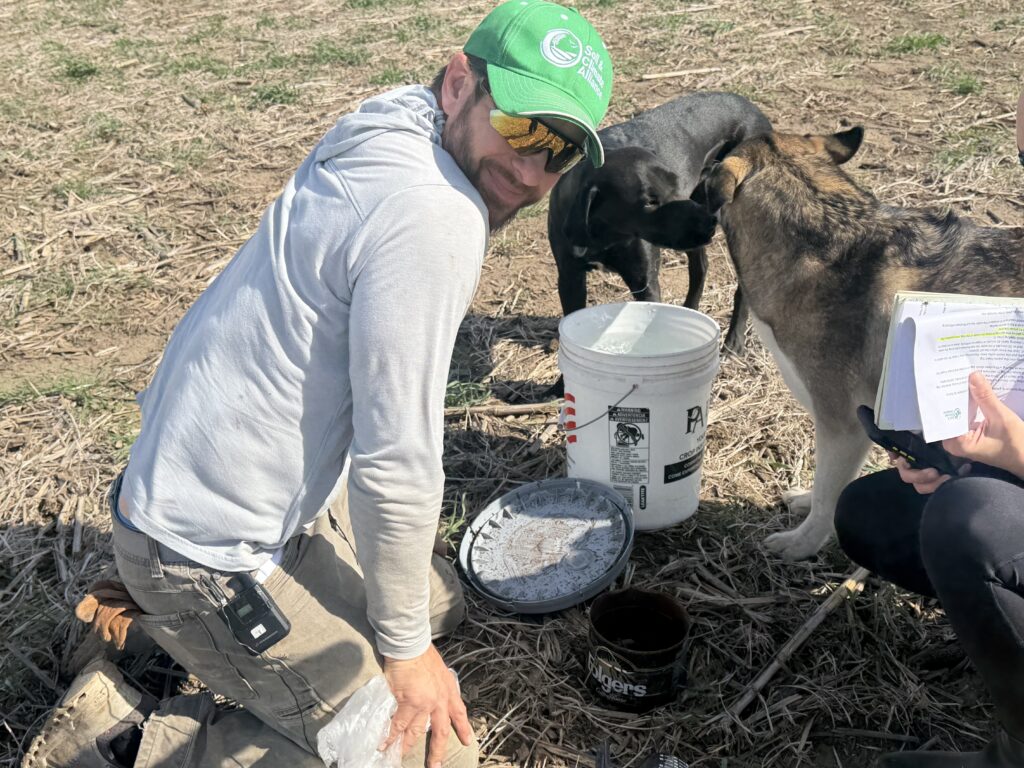
The next day, with his partner and sweet baby in tow, Graham did a worm count and an infiltration test to see how slowly his soil soaked up water. Healthy soil is spongy soil. It gives thirsty crops a big drink, and also helps stop farm runoff in its tracks before it flows into nearby waterways.
Along the farm fields lies Bell Creek, where Graham planted a “buffer strip” of native prairie grasses as a nature-based hack to protect downstream communities and ecosystems. It may not look like it, but this mile-long creek is part of a watershed that millions of people depend on for clean drinking water and that wildlife need to thrive. For perspective, Bell Creek flows to the Elkhorn River, to the Platte River, to the Missouri River, to the mighty Mississippi, and to the Gulf of Mexico, where agricultural fertilizer and chemicals have created one of the biggest dead zones on earth, starving marine life of oxygen. It doesn’t have to be this way. We can take notes from traditional Indigenous stewardship Graham taught us about in order to heal our water, nourish our bodies, and respect the wild spaces we all depend on for our shared survival.
Big Ag’s impact on family farms and what can be done
Only 5% of Nebraska farms use cover crops, one example of how outdated policies have systematically favored a small handful of commodity crops. For decades, there’s been a deep consolidation of power with the rise of corporate Big Ag, harming family farming traditions. This makes it challenging for small farms to diversify and practice multi-solve solutions on their land.
The good news is people like Graham have a vision for stronger policies that prioritize local economies, a healthier food system, climate action, and clean water.
I got the chills hearing Graham’s passion and care for the future. It makes sense. We just need the political will and investment to realize his vision.
What’s next?
Sign up for our Water Cooler newsletter to hear about our trainings and resources and follow us on LinkedIn, Instagram, Bluesky, and YouTube.
